Here's the leetcode #2 link for the problem.
Okay, let's solve the problem, Start by analyzing the question:
- Add Two Numbers
You are given two non-empty linked lists representing two non-negative integers. The digits are stored in reverse order, and each of their nodes contains a single digit. Add the two numbers and return the sum as a linked list. You may assume the two numbers do not contain any leading zero, except the number 0 itself.
Examples:
Example 1:
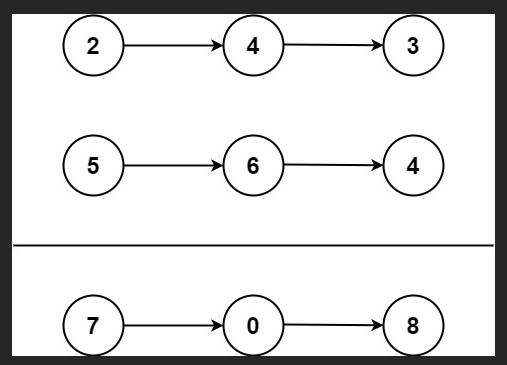
Input: l1 = [2,4,3], l2 = [5,6,4] Output: [7,0,8] Explanation: 342 + 465 = 807.
Example 2:
Input: l1 = [0], l2 = [0] Output: [0]
Example 3:
Input: l1 = [9,9,9,9,9,9,9], l2 = [9,9,9,9] Output: [8,9,9,9,0,0,0,1]
Approach — using linked list with dummy head:
- Use dummy head linkedList and the response will always be
head.Next - Track the current iteration using current variable, since we don't want to modify the head linkedList. This approach is doable since the variable is using same reference / same pointer value
- Calculate total from
l1.Val + l2.Val + carry. Carry initialized with 0 value. The Carry value is changed when total is greater than 9 or can be received viatotal / 10, to get exact carry value. - Only modify and iterate with current Linklist node, dont use head node to iterate
- update
L1 and L2if only theL1 and L2is not Null
let's deep dive to the code:
package addtwonumbers

type ListNode struct {
    Val int
    Next *ListNode
}

func addTwoNumbers(l1 *ListNode, l2 *ListNode) *ListNode {
	dummyHead := &ListNode{}
	// we want to set the current same as head. The return value is always be head.Next
	current := dummyHead
	carry := 0
	// keep iterate the loop with l1 or l2 is available or carry is available
	// we use the l1 or l2 directly to get value of each node
	// wa use the carry > 0 to use the carry until last digit
	for l1 != nil || l2 != nil || carry > 0 {
		total := 0
		if l1 != nil {
			total += l1.Val
			l1 = l1.Next
		}
		if l2 != nil {
			total += l2.Val
			l2 = l2.Next
		}
		// add total with carry
		total += carry
		// set the next value with total % 10
		// let's say L1.Val is 7 l2.Val is 8, so the total will be 15
		// the val will be total % 10 = 5
		current.Next = &ListNode{Val: total % 10}
		// the carry will be total / 10 = 1
		// if the carry > 0  and l1 or l2 is nil, the iteration is keep going. This ensure the latest value is correct until the last number
		carry = total / 10
		// iterate the current to next, since we want to assign the value to next node
		current = current.Next
	}
	return dummyHead.Next
}
and let's add unit test for this, we'll be using table test driven approach.
package addtwonumbers

import (
	"reflect"
	"testing"
)

func Test_addTwoNumbers(t *testing.T) {
	type args struct {
		l1 *ListNode
		l2 *ListNode
	}
	tests := []struct {
		name string
		args args
		want *ListNode
	}{
		{
			name: "first",
			args: args{
				l1: &ListNode{Val: 2, Next: &ListNode{Val: 4, Next: &ListNode{Val: 3}}},
				l2: &ListNode{Val: 5, Next: &ListNode{Val: 6, Next: &ListNode{Val: 4}}},
			},
			want: &ListNode{Val: 7, Next: &ListNode{Val: 0, Next: &ListNode{Val: 8}}},
		},
		{
			name: "second",
			args: args{
				l1: &ListNode{Val: 0},
				l2: &ListNode{Val: 0},
			},
			want: &ListNode{Val: 0},
		},
		{
			name: "third",
			args: args{
				l1: &ListNode{Val: 9, Next: &ListNode{Val: 9, Next: &ListNode{Val: 9, Next: &ListNode{Val: 9, Next: &ListNode{Val: 9, Next: &ListNode{Val: 9, Next: &ListNode{Val: 9}}}}}}},
				l2: &ListNode{Val: 9, Next: &ListNode{Val: 9, Next: &ListNode{Val: 9, Next: &ListNode{Val: 9}}}},
			},
			want: &ListNode{Val: 8, Next: &ListNode{Val: 9, Next: &ListNode{Val: 9, Next: &ListNode{Val: 9, Next: &ListNode{Val: 0, Next: &ListNode{Val: 0, Next: &ListNode{Val: 0, Next: &ListNode{Val: 1}}}}}}}},
		},
	}
	for _, tt := range tests {
		t.Run(tt.name, func(t *testing.T) {
			if got := addTwoNumbers(tt.args.l1, tt.args.l2); !reflect.DeepEqual(got, tt.want) {
				t.Errorf("addTwoNumbers() = %v, want %v", got, tt.want)
			}
		})
	}
}
And the test result will be
reza@banyil:~/Desktop/leetcode/2._Add_Two_Numbers$ go test . -v
=== RUN   Test_addTwoNumbers
=== RUN   Test_addTwoNumbers/first
=== RUN   Test_addTwoNumbers/second
=== RUN   Test_addTwoNumbers/third
--- PASS: Test_addTwoNumbers (0.00s)
    --- PASS: Test_addTwoNumbers/first (0.00s)
    --- PASS: Test_addTwoNumbers/second (0.00s)
    --- PASS: Test_addTwoNumbers/third (0.00s)
PASS
ok      github.com/elangreza14/leetcode/2._Add_Two_Numbers0.004s
All test is passed, and that's it, hope you found this helpful.